
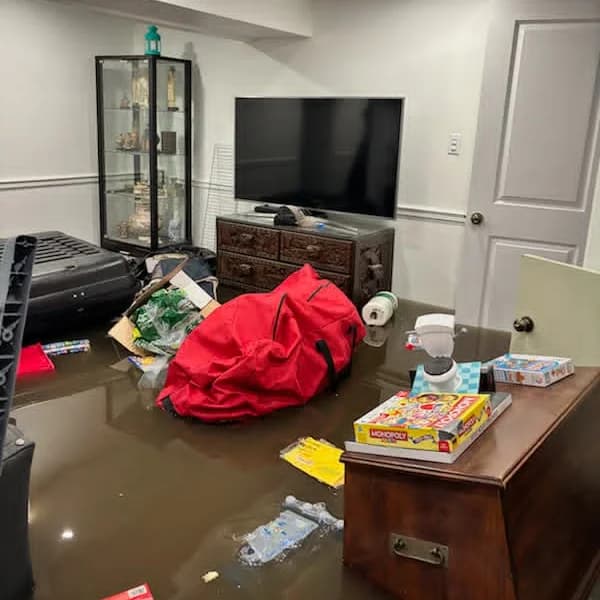
On June 20, 2026, flash flooding tore through Montreal's West Island and the Vaudreuil-Soulanges region after a band of intense thunderstorms stalled over the area for several hours. Pierrefonds-Roxboro and Dollard-des-Ormeaux saw some of the worst of it, with several streets turned into rivers and municipal drains overwhelmed faster than they could keep up. Île-Perrot and multiple municipalities across Vaudreuil-Soulanges reported similar scenes — flooded basements, stranded vehicles, and roads closed for hours. Hydro-Québec reported tens of thousands of customers without power at the peak of the storm, which knocked out sump pumps in basements at the exact moment they were needed most.
If your home took on water on June 20, the flooding itself was only the first problem. What happens in your basement over the next few days matters just as much — and for most homeowners, that part is far less visible than a wet carpet or a stained ceiling.
Video: CTV News Montreal (via YouTube)
Mold Doesn't Wait for a Convenient Weekend
Mold spores are already present in virtually every home. What they need to start colonizing a surface is moisture, and enough of it, for long enough — and a basement that's just flooded meets that condition almost immediately. Under normal indoor temperatures, visible mold growth can begin appearing on wet organic materials, like drywall paper, carpet backing, and wood trim, in as little as 24 to 72 hours.
That window is shorter than most people expect, which is exactly why "I'll deal with it this weekend" is often already too late by the time the weekend arrives.
What to Remove Immediately, Not Dry Out
If carpet, carpet padding, or baseboards sat in standing water for any length of time, the general rule is that they come out, not dry out. Carpet padding in particular acts like a sponge; it rarely dries fully in place even with fans running around the clock. The bottom 30 to 60 centimetres of drywall in a flooded room usually tells a similar story — the paper facing and the gypsum core both hold moisture long after the surface looks and feels dry, and cutting that section out is almost always faster and cheaper than trying to save it.
Why "It Looks Dry" Is Misleading
This is the part that catches people off guard. A concrete floor or the face of a wall can look and feel bone-dry within a day, while the material behind it — inside a wall cavity, under a subfloor, or behind an uninsulated cold room wall — stays damp for days or weeks longer. Surface appearance simply isn't a reliable way to judge how much moisture is actually trapped, which is why a proper assessment relies on moisture meters and thermal imaging instead of a visual check.
DIY Drying vs. Calling in a Professional
For a small, contained amount of water — a few centimetres in one corner, cleaned up within hours — good ventilation, fans, and a dehumidifier running for several days is often genuinely enough. A professional flood mold assessment is worth booking when water sat for an extended period, covered a large area, reached electrical outlets or baseboards, or when you simply can't confirm that everything underneath has fully dried. If you're not sure which category your situation falls into, that uncertainty on its own is a good reason to get it checked before closing the wall back up.
Document Before You Discard Anything
If you're planning to file an insurance claim, take dated photos — and video, where practical — of the damage before you start removing flooring, drywall, or damaged belongings. Insurers generally want to see the extent of the damage as it stood, not after cleanup has already begun. Keep receipts for anything you dispose of or replace, and if a professional assesses the moisture levels in your home, ask for a written report. It becomes part of your claim's documentation regardless of how the claim itself is ultimately decided.
If You're Still Dealing With This
We're currently booking free, on-site assessments for homes affected by the June 20 flooding across Pierrefonds-Roxboro, Dollard-des-Ormeaux, Île-Perrot, and the Vaudreuil-Soulanges corridor. We use a boroscope, moisture meters, and thermal imaging to find out exactly where water is still trapped, without opening up a single wall to guess. If your basement flooded and you're still inside that 72-hour window, the fastest way to protect your home is to find out what's actually still wet — not just what looks dry from the top of the stairs.
Dealing with water damage or suspected mold?
Call 514-943-5690 — 24/7 emergency response across the West Island and Vaudreuil-Soulanges.